www.telegraph.co.uk/finance/economics/99...e-inflation-IMF.html
Billions of pounds of QE unlikely to cause inflation - IMF
Central banks can unleash billions of pounds more quantitative easing with little threat of stoking inflation, according to analysis by the International Monetary Fund
Work by economists at the Washington-based institution found the historic link between unemployment and inflation has weakened “over the past several decades” and that even a sharp fall in joblessness would not lead to spiralling price rises.
“Looking to the future, our analysis suggests that ongoing monetary accommodation is unlikely to have significant inflationary consequences, as long as inflation expectations remain anchored. In this regard, preserving central banks’ independence is key,” the IMF said in a pre-released chapter of next week’s World Economic Outlook.
“Indeed ... any temporary over-stimulation of the economy – perhaps stemming from misperception about the size of output gaps – is likely to have only small effects on inflation.”
The findings will be welcomed by the Chancellor, who is pinning his hopes for growth on the incoming Bank of England Governor Mark Carney. Mr Carney has indicated he is willing to take radical action to revive growth in the UK.
The Bank has already injected £375bn into the economy through QE, the largest monetary stimulus of any developed country as a proportion of GDP. Sir Mervyn King, the outgoing Governor, has called for another £25bn for the last two months – but has been outvoted by his fellow policymakers.
It also follows comments by IMF managing director Christine Lagarde over the weekend, when she described Japan's massive new money priting programme as "a welcome step". However, she warned there was "a limit to how effectively monetary policy can continue to shoulder the lion’s share of this effort".
Translation: we should print loads of money, but we should also steal people's bank deposits too.
Interesting that she mentioned Japan being a "welcome step" because I think there is quite strong evidence that the Japanese currency has been devalued. Here is just one small example:
www.nasdaq.com/article/currencies-yen-sl...8-01134#.UWUvtxc3uSo
Japan's currency fell Tuesday, struggling at four-year lows against the U.S. dollar as it extended its dive in the wake of fresh Japanese monetary stimulus.
The U.S. dollar (USDJPY) bought 99.40 yen in Asian trade, compared with Yen99.21 in North American trade late Monday.
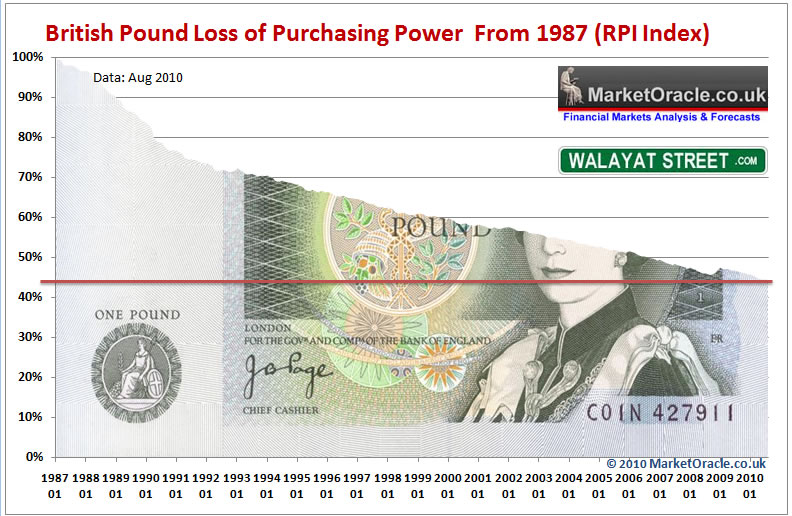
You can see the historical purchasing power of sterling here:
But more quantitative easing won't devalue it further, of course!
Edit: Oh, I should just mention as well that the first of those images is based on the RPI Index, ie. the government's own figures. This is known to be hugely optimistic and also excludes several essential items that actually make the real picture far worse.